
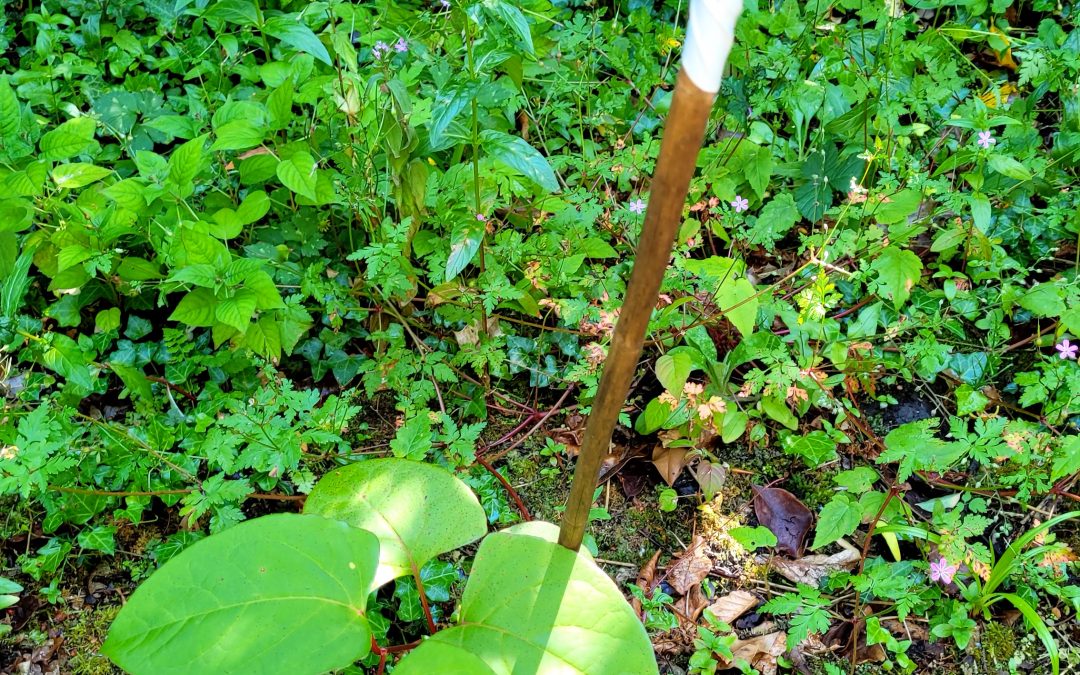
Many homeowners ask a simple question:
How can I tell if my property has Japanese knotweed?
Early identification is extremely important. Japanese knotweed (Fallopia japonica) spreads quickly via underground rhizomes and can become increasingly difficult to control over time.
Several methods can help confirm whether Japanese knotweed is present on your land.
Visual Identification
The most common way to identify Japanese knotweed is through visual inspection.
The plant has several distinctive features:
-
large heart-shaped green leaves
-
hollow bamboo-like stems with purple speckles
-
dense clusters of small white flowers in late summer
-
rapid growth reaching 2–3 metres in height
During winter the leaves fall, but the brown hollow canes often remain standing. These dead canes can help identify previous growth.
Japanese knotweed can grow in gardens, along fences, near buildings, and beside waterways.
However, several plants can look similar. For example, Russian vine, bamboo, and bindweed sometimes confuse one another.
For this reason, professional identification is often recommended.
Aerial Mapping
Large infestations can sometimes be identified using aerial mapping or drone surveys.
High-resolution aerial images help surveyors spot the plant’s distinctive growth pattern across larger areas.
This method works well on:
-
development sites
-
railway land
-
commercial properties
-
large gardens or estates
Aerial mapping helps identify areas that may need closer inspection on the ground.
Ground Penetrating Radar (GPR)
Ground penetrating radar is a non-invasive technology used to detect underground structures.
In some situations, GPR can help identify areas where Japanese knotweed rhizomes may exist below the surface.
However, the technology has limitations and is not always necessary for residential surveys.
Most knotweed infestations can be identified through careful inspection and site knowledge.
Professional Japanese Knotweed Survey
The most reliable way to confirm the presence of Japanese knotweed is through a specialist survey.
A professional surveyor will carefully inspect the property and the surrounding land. They will identify the plant, map the infestation, and assess the risk to buildings.
A typical survey includes:
-
a detailed site inspection
-
identification of Japanese knotweed growth
-
mapping of the affected areas
-
Risk assessment based on distance from structures
-
recommendations for treatment or management
The survey report provides clear guidance for property owners, buyers, and mortgage lenders.
Why Early Identification Matters
Japanese knotweed spreads mainly through rhizome fragments in the soil.
Even a very small fragment can grow into a new plant.
Early identification allows treatment to begin before the infestation spreads further.
This can significantly reduce treatment time and overall cost.
Suspect Japanese Knotweed?
If you believe Japanese knotweed may be growing on your property, professional advice can provide peace of mind.
A specialist survey will confirm whether the plant is present and recommend the best course of action.
For expert advice or to arrange a survey, contact:
Stephen Singleton
PCA-Accredited Japanese Knotweed Surveyor
📞 07753 682333
Early action helps protect your property and prevents the plant from spreading to neighbouring land.