
How Close Can Japanese Knotweed Grow to Your House?
Understanding the 7-Metre Rule and Property Risks
Many homeowners ask the same question.
How far from a house can Japanese knotweed grow?
Japanese knotweed is a concern because of its aggressive growth and extensive underground rhizome system.
If the plant grows near buildings, it can cause problems for property owners.
However, many myths exist about the plant and the risks it poses to houses.
Understanding the real risks helps homeowners make better decisions about treatment and control.
What Is Japanese Knotweed?
Japanese knotweed (Fallopia japonica) is an invasive perennial plant introduced to Britain during the nineteenth century.
It was originally planted in gardens for its rapid growth and bamboo-like appearance.
However, the plant quickly escaped cultivation and spread across the countryside and urban areas.
Today, Japanese knotweed is widely recognised as one of the UK’s most problematic invasive plants.
The plant spreads via an underground rhizome system rather than by seed.
These rhizomes can:
-
Spread up to seven metres horizontally from the parent plant.
-
Grow several metres deep into the soil.
-
Regrow from extremely small fragments
Because of this, the visible stems often represent only a small part of the plant.
The Old “7-Metre Rule” Explained.
For many years, surveyors used what became known as the 7-metre rule.
This rule suggested that Japanese knotweed growing within seven metres of a building or boundary could present a potential risk.
The rule was developed based on research into how far knotweed rhizomes may spread underground.
Mortgage lenders and surveyors often use this distance when assessing properties affected by knotweed.
However, the rule caused confusion among homeowners.
Many people believed the plant must always be removed if it appeared within seven metres of a house.
In reality, the 7-metre rule was never a legal requirement.
It was simply guidance used in property surveys.
Updated RICS Guidance on Japanese Knotweed
In 2022, the Royal Institution of Chartered Surveyors (RICS) introduced updated guidance.
Instead of relying on the simple 7-metre rule, surveyors now assess the overall risk to the property.
The updated system focuses on several factors:
-
Distance from buildings
-
Size of the infestation
-
Whether the plant is spreading
-
Potential impact on structures
Surveyors now place infestations into management categories rather than relying on a fixed distance.
This approach provides a more accurate assessment of the actual risk.
Can Japanese Knotweed Damage Your House?
Japanese knotweed has a strong reputation for damaging buildings.
However, the reality is often more complex.
The plant rarely breaks through solid concrete foundations.
Instead, it tends to exploit existing weaknesses in structures.
For example, knotweed may grow through:
-
Cracks in paving or patios
-
Weak garden walls
-
Gaps in drainage systems
-
Retaining walls
-
Lightweight garden structures
Because the plant grows quickly and produces dense stems, it can also create maintenance issues around buildings.
Why Knotweed Close to a House Causes Concern
Even when knotweed does not damage the structure directly, it can still affect property owners.
Common concerns include:
-
Reduced property value
-
Mortgage lender requirements
-
Difficulty selling the property
-
Disputes with neighbours
Mortgage lenders often require a professional management plan when Japanese knotweed is present near a property.
This ensures the plant is controlled and monitored over time.
Legal Responsibilities for Homeowners
It is not illegal to have Japanese knotweed growing on your property.
However, the law requires property owners to prevent the plant from spreading into neighbouring land.
If knotweed spreads from your property, neighbours could potentially pursue legal action.
In addition, Japanese knotweed is classified as controlled waste under the Environmental Protection Act 1990.
This means any contaminated soil or plant material must be disposed of correctly.
Improper disposal can lead to penalties.
How Japanese Knotweed Is Typically Treated
Several treatment methods are commonly used to control Japanese knotweed in the UK.
The most suitable method depends on the size of the infestation and the plant’s location.
Herbicide Treatment
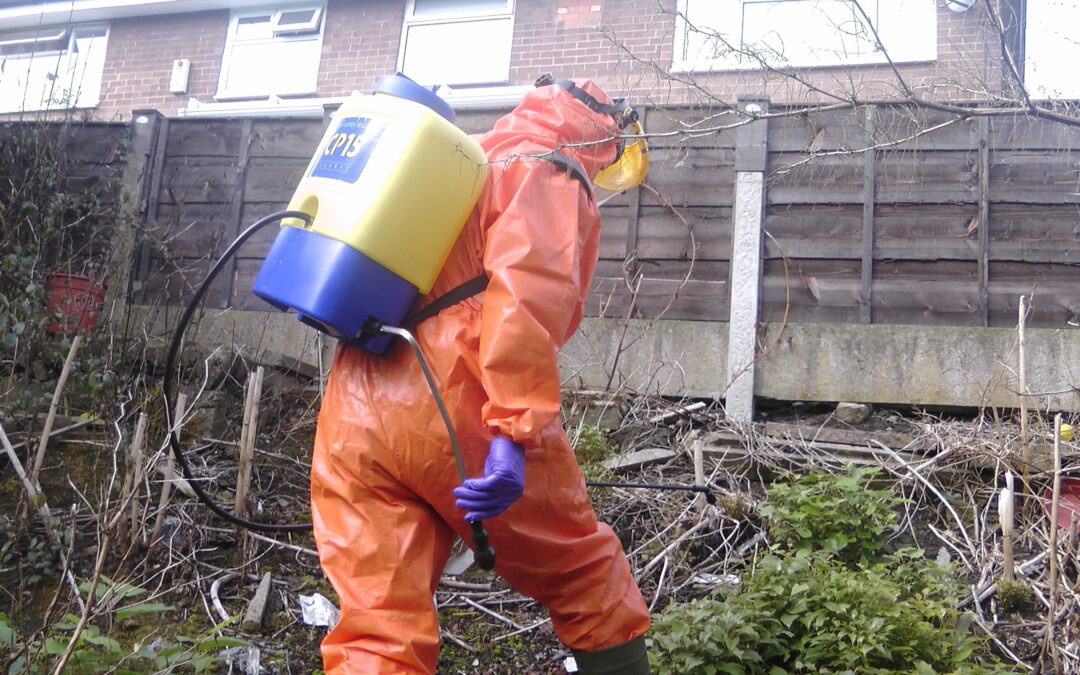
Herbicide treatment remains the most widely used control method.
Specialist contractors apply systemic herbicides directly to the plant.
Over time, the chemical moves through the stems and into the rhizome system.
Most treatment programmes take three to five years to achieve reliable control.
Excavation and Removal
Excavation involves digging out contaminated soil and rhizomes.
The material must then be transported to a licensed landfill facility that accepts invasive plant waste.
This method removes the plant quickly but can be expensive.
Developers often use excavation during construction projects.
Specialist Management Plans
Many homeowners choose professional treatment programmes.
Specialist companies provide:
-
Detailed management plans
-
Annual monitoring visits
-
Insurance-backed guarantees
These guarantees can help reassure mortgage lenders and potential buyers.
Why Early Identification Is Important
Early identification makes Japanese knotweed easier and cheaper to control.
Small infestations respond well to herbicide treatment programmes.
However, larger infestations may require several years of management.
Acting early also reduces the risk of the plant spreading into neighbouring properties.
Japanese Knotweed Surveys and Professional Advice
If you suspect Japanese knotweed growing near your property, a specialist survey provides clarity.
A professional survey will:
-
Confirm whether the plant is Japanese knotweed.
-
Map the affected area.
-
Assess the level of risk.
-
Recommend appropriate treatment options.
Early advice helps prevent unnecessary spread and protects property value.
Need Help Identifying Japanese Knotweed?
At Japanese Knotweed Plus, we provide professional knotweed surveys and treatment plans.
Our services include:
-
Detailed survey reports
-
Professional treatment programmes
-
Long-term monitoring and management
If you would like advice, please contact:
Stephen Singleton
Japanese Knotweed Plus Ltd
Mobile: 07753 682333
Early action can prevent the plant from spreading and reduce long-term costs.