
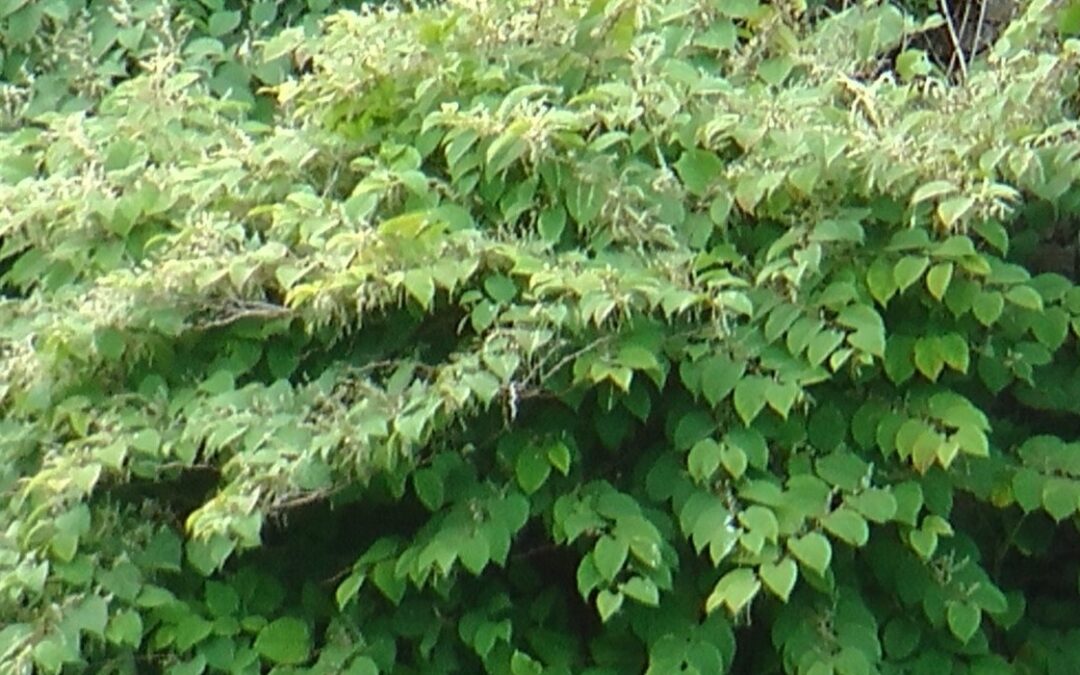
Many property owners ask a simple question:
What eats Japanese knotweed?
Unfortunately, the answer explains why this invasive plant spreads so easily in the UK.
Japanese knotweed (Fallopia japonica) has very few natural predators outside its native range in Japan.
Because of this, the plant grows aggressively and often dominates large areas of land.
Unlike many plants, Japanese knotweed is rarely eaten by animals, insects, or livestock.
Why Most Animals Avoid Japanese Knotweed
Japanese knotweed develops tough fibrous stems and large waxy leaves.
These characteristics make the plant unattractive to most grazing animals.
Cattle, sheep, and horses will sometimes nibble young shoots.
However, they rarely eat enough to control the plant.
More importantly, knotweed spreads through underground rhizomes.
Even heavy grazing will not destroy this deep root system.
As a result, animals cannot control established infestations.
The Only Insect That Targets Japanese Knotweed
Scientists have searched for biological control insects for many years.
The most promising insect is the Japanese knotweed psyllid (Aphalara itadori).
This small sap-sucking insect originates from Japan, where Japanese knotweed naturally grows.
In its native environment, the psyllid helps keep knotweed populations under control.
What Does the Psyllid Do?
The insect feeds on Japanese knotweed by sucking sap from young leaves and stems.
This feeding causes several problems for the plant:
-
leaf curling
-
reduced growth
-
weaker stems
-
slower spread
Over time, large populations of psyllids may weaken knotweed stands.
Biological Control Research in the UK
Researchers introduced Aphalara itadori in controlled trials within the UK.
The aim was simple.
Scientists wanted to see if the insect could slow the spread of Japanese knotweed naturally.
Early trials began around 2010 and continue today.
However, results remain mixed.
Cold weather and predators reduce psyllid survival in many areas.
Therefore, the insect has not yet provided large-scale control of Japanese knotweed in Britain.
Can Livestock Eat Japanese Knotweed?
Some landowners ask whether livestock could control knotweed.
In theory, animals may eat young shoots in spring.
Japanese knotweed also contains nutrients and plant compounds such as resveratrol.
However, several problems exist.
First, grazing rarely destroys the underground rhizome network.
Second, animals usually avoid mature plants.
Third, moving contaminated plant material can spread the infestation.
Because of these risks, livestock grazing is not considered a reliable control method.
The Real Reason Knotweed Spreads So Easily
Japanese knotweed spreads primarily through rhizome fragments in soil.
A piece of root weighing less than a gram can grow into a new plant.
Construction work, landscaping, and soil movement often spread these fragments.
Without natural predators, the plant spreads rapidly across gardens, riverbanks, railway lines, and development sites.
The Most Effective Way to Control Japanese Knotweed
Because few animals eat Japanese knotweed, professional control methods are normally required.
The most reliable options include:
-
professional herbicide treatment programmes
-
excavation and controlled disposal
-
long-term management plans with monitoring
A properly designed treatment programme normally takes three to five years to achieve reliable control.