
Japanese Knotweed Removal Process
Many domestic customers ask whether we offer a Japanese knotweed removal service, and the answer is yes.
We always mention that placing Japanese knotweed in the recycling bins is an offence, as the local authorities can fine you heavily if they catch you.
Japanese knotweed removal can be carried out in two ways: by application of herbicide or by mechanical means. The latter is usually the most expensive and, in some cases, the least effective. Some companies use excavators to dig out the contaminated soil. Then, they put the soil into a screening machine to separate the plant material from the soil.
Operatives then pick up the small rhizome or plant fragments in the screened soil. If the soil is heavy, sticky clay, separating the plant material from the soil can be challenging. The Japanese knotweed material will be incinerated or taken to a specialist landfill site.
The Environment Agency and the government
always advise that the best way to remove Japanese knotweed is to keep the plant material on-site. Japanese knotweed removal by herbicide treatment keeps the risk of spreading off-site to the broader environment to an absolute minimum. However, larger companies offer Japanese knotweed removal by excavation when herbicide treatment is too time-consuming. For many development sites, mechanical removal of Japanese knotweed may be the only option for the developer.
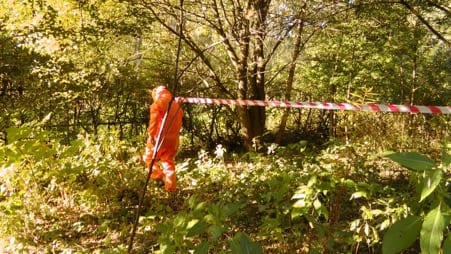 The main problem with mechanical removal is the potential for human error, as it is straightforward for the operative to miss tiny rhizome fragments in the screened soil. The fragments may be put back onto the land and then start to regrow later, after the Japanese knotweed company has left the site. Small pieces could also be transferred between sites on vehicles and equipment used by developer companies if they are not sufficiently cleaned before leaving the site.
All the soil contaminated by Japanese knotweed must be transported to the specialist landfill site. Due to the high landfill tax, the cost per cubic tonne is much higher than for ordinary waste. In addition, a paper trail and waste transfer licence must accompany the Japanese knotweed removal to the landfill site.
Alternatively,
Japanese knotweed can be removed from the infested area and bound elsewhere on the site. This may usually be carried out by a specialist Japanese knotweed company that digs out the Japanese knotweed-contaminated soil down to a depth of 2-2.5 meters and possibly up to 7 meters from the edge of the Knotweed stand. The soil will be placed in an on-site area that will not be under development. The area will have to be fenced off to limit access. Clear signage on the fence states that contractor details dealing with Japanese knotweed must be provided. The area will then be treated with herbicide, which may take several years.
Note that even after all jobs associated with Japanese knotweed removal by either chemical or mechanical means have been done, there is still a probability of new regrowth in the future. Animals such as foxes and badgers are the primary means of spreading the plant. They can bring rhizome fragments onto their fur. Rhizome fragments as small as 0.8 grams can regenerate into new plants.
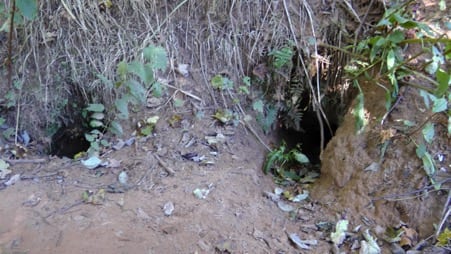
We have been on sites where badgers and foxes have dug their sets and dens among the Japanese knotweed crowns. Many clients are pretty shocked when we mention that the likely reason the plant is in their garden is because of foxes or badgers.
 Japanese knotweed removal by scrupulous builders is another way the plant spreads. Waste material tends to be fly-tipped into back streets, disused wasteland, and similar areas. The council will then clear the waste without checking for Japanese knotweed material. The material may then end up at the local landfill site, thus allowing the plant to re-establish itself.
With Japanese knotweed removal by herbicide poisoning,
You are guaranteed that the plant will stay on-site. It is the most cost-effective way to treat Japanese knotweed. Most professional Japanese knotweed companies offer this service and ensure the plant will be killed, even if treatment continues for two to three years, followed by a couple of years of monitoring.
There are also situations in which Japanese knotweed removal by mechanical means cannot be used due to location and the disturbance to the local area. We tend to find large stands of Japanese knotweed along rivers’ banks. The strong currents can sweep the Japanese knotweed down the river. Attempting to excavate along the riverbank could cause the river to breach its banks and lead to local flooding.
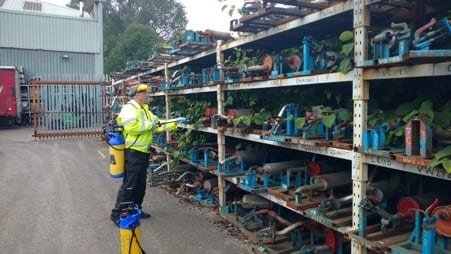 Railways also have a massive problem with Japanese knotweed. The trains can spread plants along the track, as the plants often grow onto it and can be easily pulled by the train and dropped farther down the track.
It is worth mentioning that in the highlands of Scotland,
Japanese knotweed removal is forbidden, and you could face a fine if you try to remove Japanese knotweed. Otters use dense knotweed stands to secretly move from one mating ground to another, undetected by humans. The otter populations in the protected areas are doing well.
In summary, Japanese knotweed removal by mechanical means is almost always not cost-effective and imposes the risk of spreading the plant to the broader environment. Japanese knotweed removal by chemical treatment would be a fair, safer, and cost-effective option.